Hours of retyping
Every company asks for the same history, the same work authorization answers and the same resume, each in a slightly different form.

Truefill finds roles you qualify for, tailors your resume and fills every field on Greenhouse, Ashby and Lever, then checks each answer against your real background. Anything it can’t confirm is held for you, and nothing is ever sent without you.
Launch · Q3 2027
to the start of Q3 2027
Pilot results from the working engine on the founder’s own job search, November 2026. Not yet independently validated.
[ 01 ] // The problem
A serious search means hundreds of forms that ask the same questions in different ways. The tools that promise to do it for you trade accuracy for volume.
Every company asks for the same history, the same work authorization answers and the same resume, each in a slightly different form.
Mass-apply tools fill what they can and guess the rest. A wrong answer on sponsorship or a consent box can end an application before a person reads it.
After a week of applying, few people can say which resume went where, what they answered, or which applications actually went through.
[ 01b ] // Who it is for
The job is the same for all four: get your best application in front of the right employers early, without retyping your history and without a wrong answer going out under your name.
Entry-level roles that fit your degree, internships and projects, with a resume that makes the most of them. Truefill picks from wording you approved and never writes a claim you can’t back.
A steady batch of strong, fresh roles every morning, so the search keeps moving while you prepare for interviews. You review the batch. You don’t type it.
Your current employer is blocked, nothing is public, and you choose every application that goes out.
Your sponsorship and work authorization answers are stored once. Only you can change them, and Truefill uses them word for word. If a form asks something new about your status, that application waits for you.
Every form asks for the same history in a slightly different way. Set up your background once, and answer a new question once. Truefill remembers it.
Tools that send applications you never see can send answers you would never give. Truefill does the finding, tailoring and filling, then waits for you.
Recruiters are flooded with applications that were never read by the person who sent them. Tools that add to the flood make things worse for every candidate, their own users included. Truefill is built for the opposite: fewer applications that are accurate, tailored and early. Most people need 20 to 50 strong applications a month, not hundreds.
[ 02 ] // The product
Set up your background once. Each batch after that takes minutes, and you see every answer before anything is sent.
Truefill reads open roles straight from company job boards, 471,395 of them in one scan, and scores each against your experience, skills, seniority and pay, with the reasons and the gaps. One role per company, so you never flood a recruiter.
Truefill reorders and rewords your real experience to match what the role asks for. It never adds a skill, title or result you don’t have, and you can see every change.
Greenhouse, Ashby and Lever at launch, with more platforms after, filled in your own browser. Legal questions use your answers only, sponsorship is never guessed, and a wrong name, a missing cover letter or an odd salary is flagged before you see it.
Every filled application lands in one queue. Checked ones passed read-back. Needs-you ones have a question only you can answer. Held ones stop, because Truefill won’t send what it can’t stand behind. Approve, and you click Submit yourself.
[ 02b ] // Setup, once
Setup is built to take about five minutes. That is a launch target, measured from install to the first filled application.
Truefill reads your name, contact details, work history, education and skills, then shows them to you to confirm. Nothing is used until you have checked it.
Are you authorized to work in the United States? Will you need sponsorship? Will you relocate? When can you start? These are never guessed.
Job titles, locations or remote, seniority and your pay floor. Truefill skips roles that state pay below it.
Gender, race, veteran and disability questions default to decline to answer. Change them if you wish. They are stored apart from the rest of your profile.
You approve the claims your resumes can use. Tailoring picks and orders from that list. It does not write new history for you.
Less common questions, such as a non-compete or a driver’s license, are asked the first time a real form needs them. Until you answer, that one job waits. Everything else keeps moving.
[ 03 ] // Architecture
You set up your facts once: your resume, your stories and your answers to the questions that matter, like work authorization and sponsorship. Truefill finds fresh roles, tailors a resume and answers for each posting from those facts only, then fills the form and reads every field back.
Every application lands in one queue: checked, needs you or held. You approve the batch and press Submit yourself, and each one leaves a receipt with every field, the resume and the time. When you correct an answer, it becomes a rule, so the next form is right the first time.
[ 03b ] // How it works, step by step
Truefill fills a field only when it can say where the answer came from. The order is fixed.
Rules match the wording of a question to the answer you gave. Each rule is audited on the answer it produces, not only on the words it matched.
Longer answers come from your own stories. Each is approved once and reused, and every draft shows the story it came from.
Pay, location and dates are computed from your facts and the posting.
A question that needs writing, a list with no matching option, or something only you can know is recorded and held for you. It is never guessed.
The check reads the page, not the value that was typed. It looks for wrong critical answers, a wrong name or link, placeholder text, a missing required cover letter, unanswered written questions and a salary box that holds the wrong figure.
Change an answer before sending and Truefill asks once whether to always answer that way. An approval covers what you approved: if a field changes afterwards, the application comes back to you.
| The form asks for | Truefill enters | Detail |
|---|---|---|
| A range, and the posting has one | The posted range | Exactly as posted. |
| One figure | The midpoint | Of the posted range, rounded to the nearest $1,000. |
| A figure, and no range is posted | A researched figure | Starting from the same employer’s other postings at that level. Never below your floor. |
| A monthly or hourly figure | The same pay, converted | Annual divided by 12, or by 2,080 hours. |
One scan and one ranking from the pilot engine, for one profile, 9 November 2026.
Freshness uses the date a role was first posted, not the date it was last edited, because an edit can make a months-old role look new. Roles that are reposted again and again, or stay open for months, are flagged and hidden by default.
[ 04 ] // Quality control
The engine behind Truefill has already filled real applications. In a 300-application pilot, a person reviewed every field before anything was sent.
| Measure | Result | How it was measured |
|---|---|---|
| Fields needing no change | 96.0% | 4,914 of 5,121 fields across 300 applications, every field reviewed by a person. 0.69 edits per application. |
| Fields answered wrong | 0.8% | 41 of 5,121. Another 165 were left blank for the person rather than guessed. |
| Right the first time, by batch | 84.6% → 100% | First batch to last over three days, as each correction became a rule. The last three batches: 1,197 of 1,197 fields. |
| Sent before a person pressed Submit | 0 of 300 | Every reviewed application waited for a person. |
| Critical read-back failures | 0 of 20 | Headless test driver on 20 live forms with real resume upload, submit blocked. The browser extension is not built yet. |
| Time to fill 20 forms | 51 s | Same test driver, 20 of 20 resumes attached. |
| Questions covered by saved rules | 89.9% | 1,982 required questions from real forms, for one person’s saved answers. |
Pilot results from the founder’s own job search, November 2026. Not yet independently validated. Interviews so far run about 1 per 100 applications, mostly from before the engine; the beta has to beat 3 per 100 before public launch.
[ 04b ] // What it is not
An application carries your name. These rules can’t be switched off for more volume.
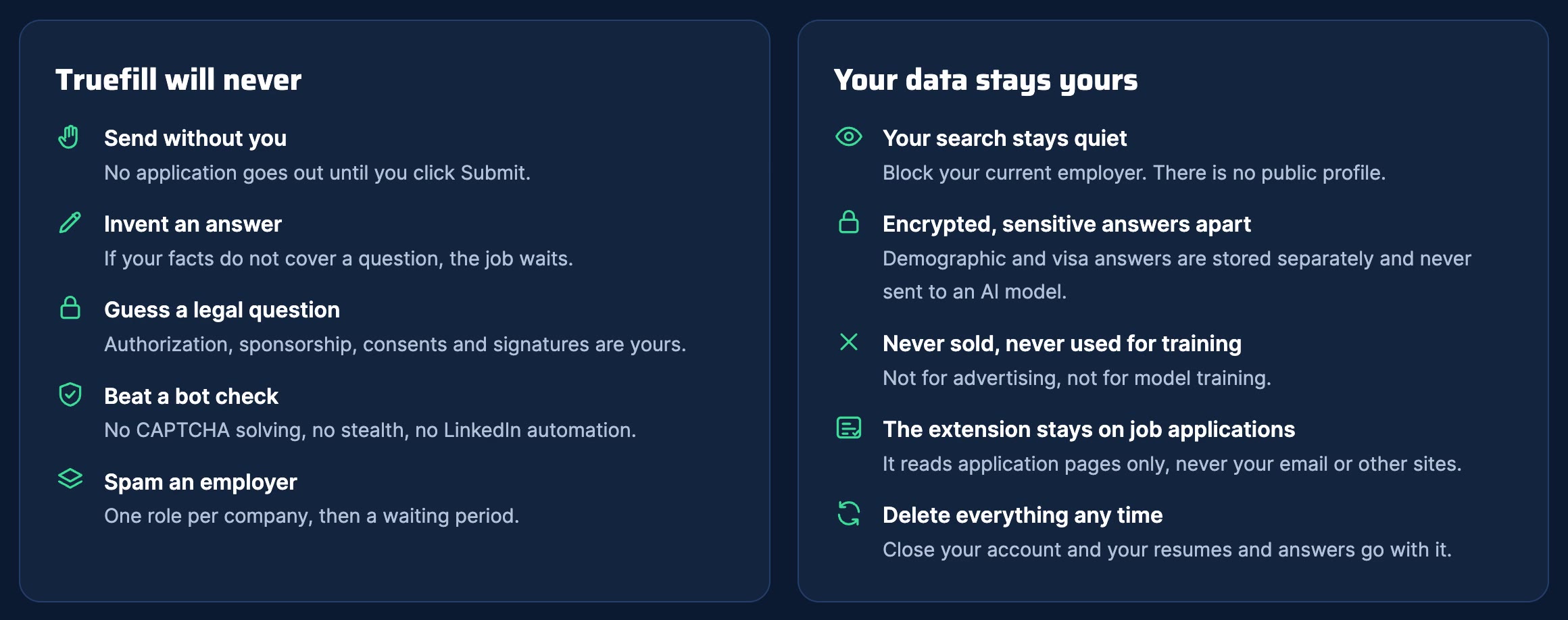
Nothing is submitted without your review. Every batch waits for you, and you make the final click.
Work authorization, sponsorship and citizenship come only from what you entered. Consents, signatures and questions about legal history are left to you.
Tailoring changes the choice, never the claim. It decides which of your approved sentences appear and in what order. If a posting asks for something none of your wording covers, you see it as a gap.
No CAPTCHA solving and no stealth. If a form asks whether you used AI or automation to apply, you answer it yourself.
One role per employer: your best match, then a waiting period. You can override it. LinkedIn is never automated.
Truefill does not guarantee interviews or offers. Its fit score is its own, worked out from the posting and your profile, and it is not the score an employer’s system will give you.
What read-back cannot do. Reading a field back catches an answer that did not take. It does not catch a wrong answer that was entered correctly. That is why legal answers come only from what you stored, and why the launch gate audits answers by sampling, with a target of under 0.2% critical errors.
What the pilot does not show. The pilot engine ran for one person, with that person’s answers behind its rules. How much a new user’s first batch needs from them has to be measured in the beta. So does the number that matters most, interviews per 100 applications.
[ 05 ] // Launch targets
| Measure | Target | How it will be measured |
|---|---|---|
| Setup | < 5 min | From install to the first filled application, for a new user. |
| Fields accepted unchanged | 95%+ | Across every beta user, not one profile. |
| Critical answer errors | < 0.2% | Audited by sampling: wrong answers that read back fine. Anything Truefill can’t confirm is held, never guessed. |
| Interviews per 100 applications | Above 3 | Beta users against their own search before Truefill. The gate for public launch. |
Targets, not results.
[ 05c ] // Questions people ask
No. It finds the roles, builds the resume, fills the form and checks every answer. Then it waits. You review the batch and press Submit on each application that is ready. Some forms also email you a short code at that point, which you paste in.
The choice and the order. Truefill leads with the sentences the posting asks about, leaves the rest out, and puts the posting title under your name. It does not rewrite your summary, add a skill you never claimed or change a number.
No. Every answer comes from the facts you gave it. If a form asks something Truefill does not know, that job waits in a short list for you. You answer once and it remembers.
They see an application you reviewed and submitted from your own browser. Truefill adds nothing to it. If a form asks whether you used AI or automation, you answer that question yourself.
Truefill is designed so that your resume and answers are encrypted, and demographic and visa answers are stored separately and never sent to an AI model. Nothing is sold or used to train models, and there is no public profile. Delete your account and everything goes with it.
Free autofill fills the easy fields and leaves the rest to you. Truefill also finds and ranks the roles, builds a version of your resume for each one, drafts the written answers from your own stories, and reads every field back before you submit.
For every role, a score with the reasons behind it and what you are missing. Roles that fall below your bar stay out of the batch, and you can put any of them back.
At launch, Greenhouse, Ashby and Lever. Truefill tells you which system a role is on before it goes in your batch.
The public launch target is Q3 2027, after a private beta. Join the waitlist at info@aurifex.com and we will write when the beta opens.
[ Au ] // The gold standard, here
Every Aurifex product must solve a real problem, be proven before it ships, and be effortless to use. Here is what that means for Truefill.
A serious job search means hundreds of forms asking the same questions, and auto-apply tools guess the answers they don’t know.
In a pilot on the founder’s own job search, 96% of 5,121 fields needed no change when a person reviewed all 300 applications, and none was sent before a person pressed Submit.
Set up once. Each batch is found, tailored, filled and checked for you, and you press Submit on each one.
[ $ ] // Outlook
| Year | 2027 | 2028 | 2029 | 2030 | 2031 |
|---|---|---|---|---|---|
| Expected net revenue (current trajectory) | $10K | $60K | $270K | $600K | $920K |
| Up to | $20K | $120K | $540K | $1.2M | $1.8M |
[ 06 ] // Release
Finding, ranking, tailoring, filling and read-back proven on real applications.
The Chrome extension with a small group of job seekers on Greenhouse, Ashby and Lever. It has to show more than 3 interviews per 100 applications and audited critical errors under 0.2% before public launch.
Truefill opens to everyone in the Chrome Web Store on Greenhouse, Ashby and Lever, with Workday and iCIMS after.
info@aurifex.com
[ AURIFEX ] // More from Aurifex
Truefill is an Aurifex product. Every Aurifex product is held to the same gold standard for AI in skilled work.







info@aurifex.com