The collector in a bookshop
You are holding a book and can’t remember whether it is already at home, perhaps under a different title. You want a yes or no before you reach the till, and the shelf it is on if the answer is yes.

Meet Octavia, the AI librarian who knows every book you own. Ask what to read next or where a book is shelved, film a bookcase to catalog it, and never buy the same book twice. Bookloft runs in your browser.
Launch · Q3 2027
to the start of Q3 2027
Times are launch targets.
[ 01 ] // Who it is for
Reading apps keep track of what you read. Bookloft knows what you own: what is on your shelves, where it is, what it is worth and what is missing. It is built first for people with hundreds of books who have bought the same one twice.
You are holding a book and can’t remember whether it is already at home, perhaps under a different title. You want a yes or no before you reach the till, and the shelf it is on if the answer is yes.
Nobody types in five hundred books. You want to walk along a bookcase with a camera, check a list, and afterwards be able to find any book by room and shelf.
You need to know what the collection would cost to replace, what it might sell for, and which books to keep, sell or give away, with photos and receipts kept beside each book.
[ 02 ] // Ask Octavia
Type a question where you would search. Octavia, Bookloft’s AI librarian, answers from your catalog in a few sentences, names the book she means, and tells you when she can’t see something.
Questions go in the same box as “do I own this?”. Octavia answers in one to four sentences from your catalog, with your reading status and ratings included.
If the catalog doesn’t say, she tells you she can’t see it. She does not guess beyond your shelves.
Titles, authors, categories and reading status. Shelf locations only when you ask where something is. Your notes, prices and orders are never sent.
[ 03 ] // Octavia’s picks
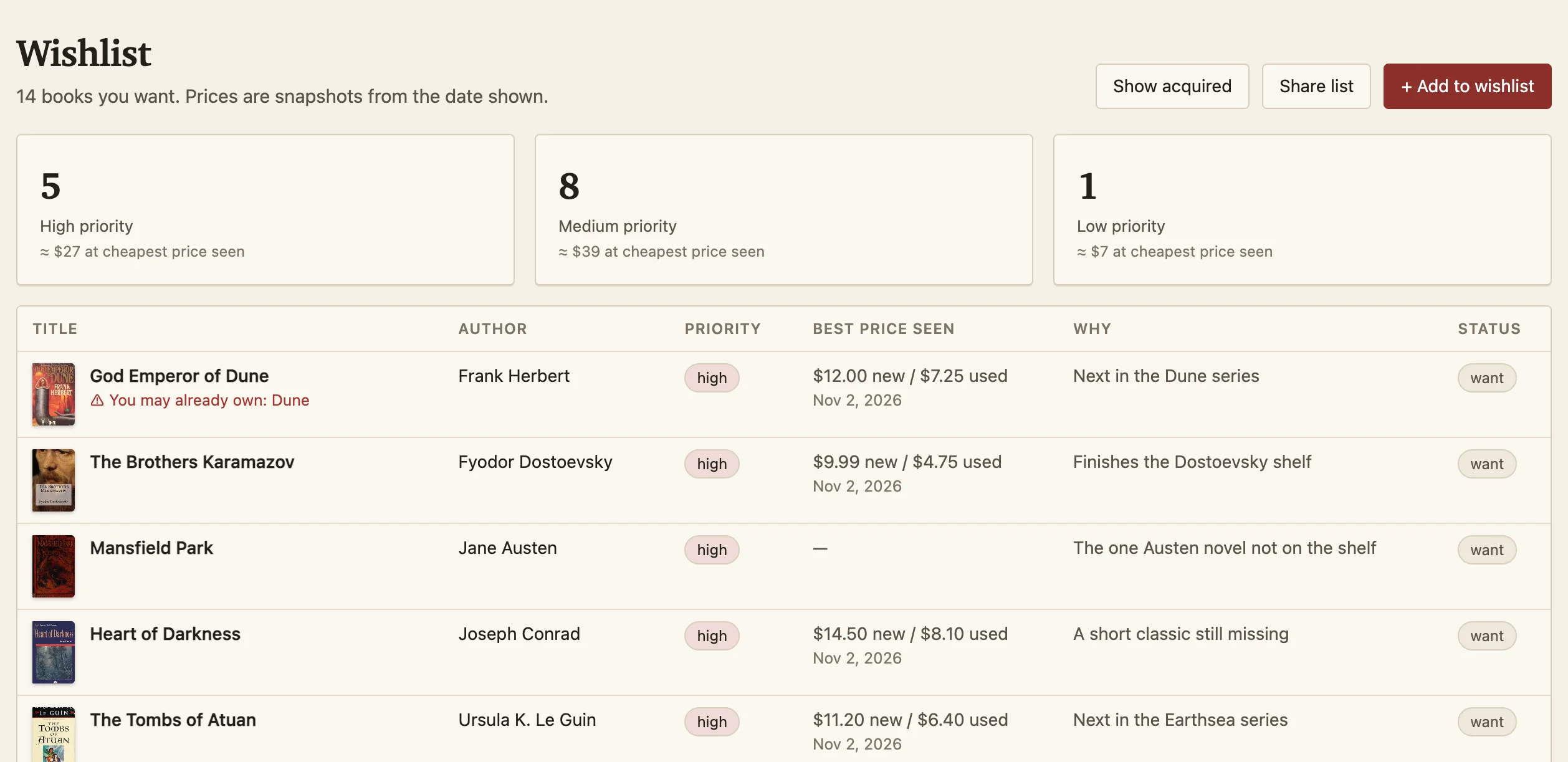
Octavia looks through everything you own and puts four shelves of picks on your desk, each with one line on why, tied to a book you already have.
For new books from authors you collect, Octavia checks the web for release dates. Anything she can’t verify is left out.
The next book in a series you have started, and the titles missing from sets you already own.
Authors you haven’t read yet, each tied to one book on your shelf that explains the pick.
She does not suggest a book you own, have on order or have on your wishlist. The rule is in her instructions, and the app enforces it a second time.
Add it to your wishlist, find a price, or mark it not interested.
A weekly look for new releases from your authors is off by default. When it finds something it marks it “New for you”.
[ 04 ] // Adding books
Film a bookcase on your phone and upload the video. Bookloft keeps the sharpest frames, reads every spine and merges what it saw into one list for you to check. Nothing is added until you say so.
Bookloft takes about two pictures a second from the video, then drops the blurry ones and the near-duplicates.
The frames are read a few at a time for titles and authors. One rule is written into the reader’s instructions: never invent a book.
A slow pan shows each book in several frames. Repeat sightings are folded into one book, and two copies standing side by side stay two.
High means the title and author were both read clearly. Medium means the author was worked out. Low means a partial read. Each row also shows how many times the book was seen and the words that were visible.
Low-confidence reads start unticked, and so do books you may already own. Nothing is added until you say so.
Every book you add keeps the frame of the shelf it was on. The video itself is deleted once the frames are cut.
Details come afterwards, and you approve them. Publisher, year and ISBN are looked up in public book databases. You review them before they are saved, and only empty fields are filled.
The other three ways use the same review. A photo of one shelf goes through the same reading, labelling and checking. So does a photo of a single book: the cover, the title page or the copyright page, for old books that have no barcode. Barcodes and imported lists need no spine reading at all.
[ 05 ] // Do I own this?
A verdict as you type: yes with the shelf it is on, on your wishlist, or not yet. It runs on your own catalog and works with AI switched off.
Try it · an example library of 152 books
“Do I own this?” is an instant check against your own catalog: close spellings, other titles of the same book, ISBN, your wishlist and copies you have lent out.
Link a book to its other titles and editions, and a retitled edition still answers “you own this”. Second copies are counted, not hidden.
When a scan or a search turns up a book you may already have, Bookloft warns you before it goes in.
[ 06 ] // The rest of the library
Every screen below is the web app, on an example library.
Covers, authors, genres and shelf locations in one list you can filter in a second. Change the shelf, category, tags or condition of many books at once, and undo it if you got it wrong.
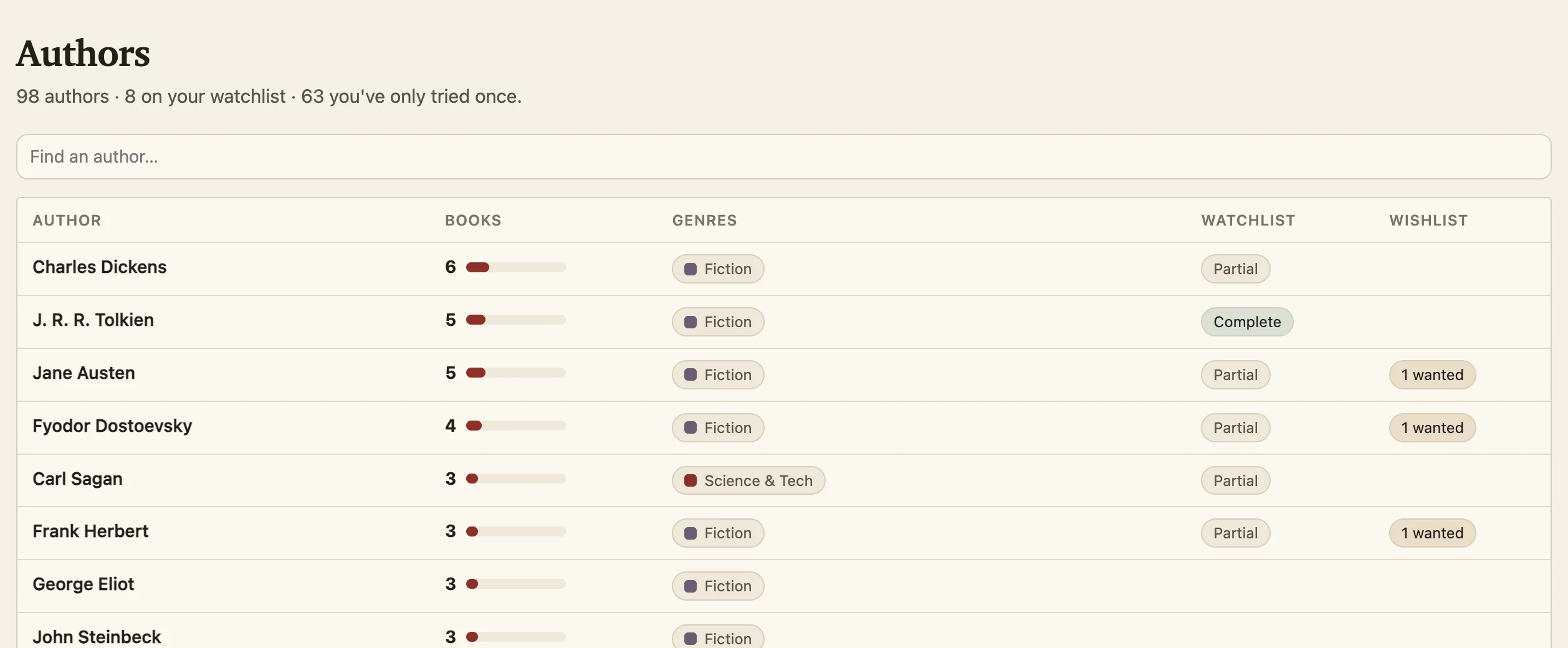
The subjects you read most, the authors you collect, which collections are complete and what’s still missing.
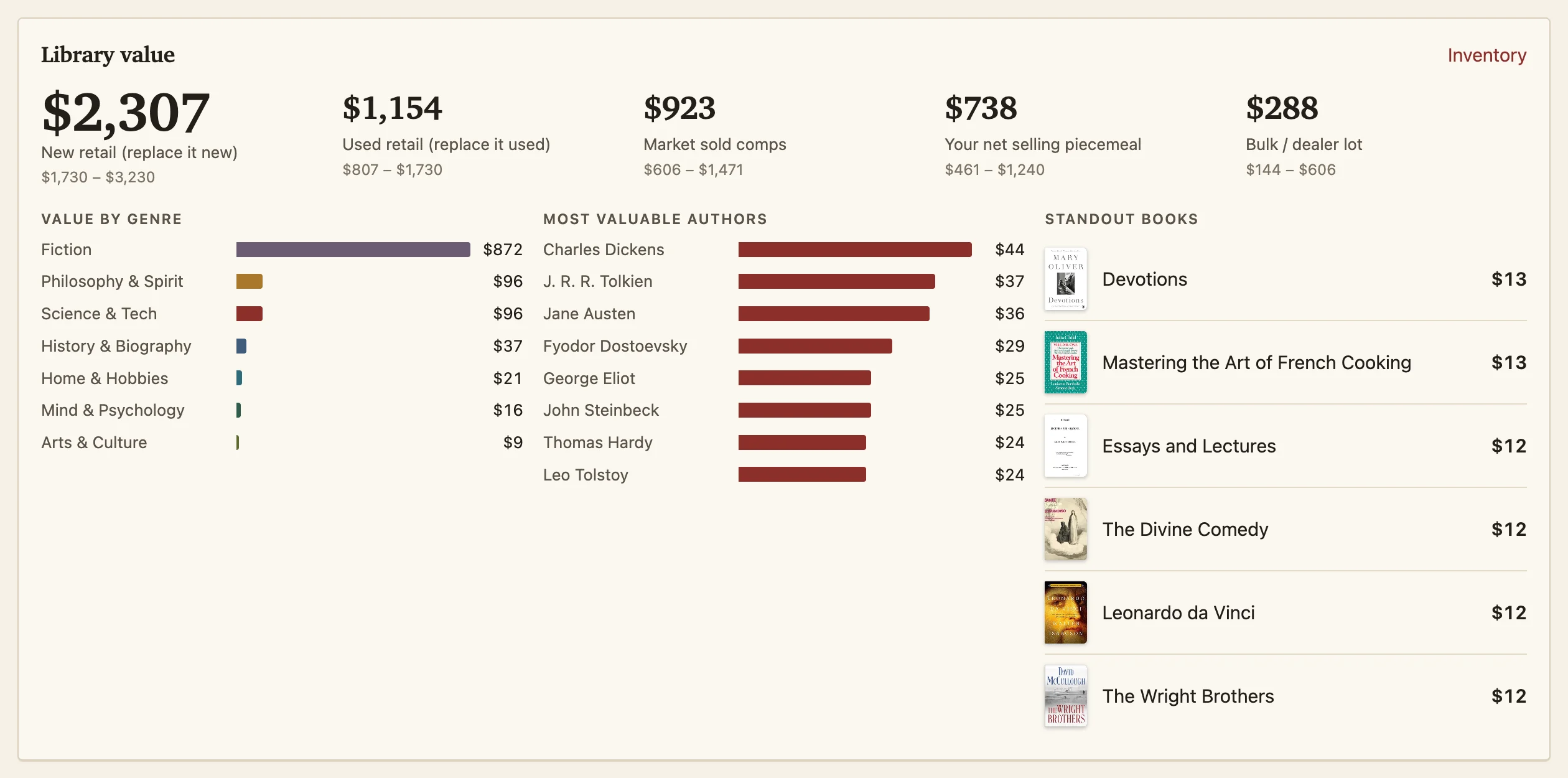
Bookloft estimates what your collection would cost to replace and what it might fetch if you sold it, by genre, author and standout book. Useful for insurance, moving and deciding what to keep.
[ 07 ] // What makes it different
Reading trackers are built around what you have read. Bookloft is built around the physical books you own, with a librarian who answers from them and a catalog that admits doubt instead of guessing.
Octavia answers questions, suggests what to read next from your own shelves and finds the gaps in your sets, and she only ever works from your catalog.
One video catalogs a whole bookcase. You check a short list instead of scanning barcodes one by one.
Each scanned book keeps its shelf photo. You can attach photos and receipts to a book and keep dated records of the whole catalog.
Bulk edits, deletes and imports can be undone, back through the last 20 actions.
A declutter view sorts books into keep, sell or donate, one decision per book.
You can take your catalog out at any time. When covers and details are fetched from public book databases, only titles and authors are sent.
How the value is worked out. The value view is arithmetic on your catalog, not AI. It shows what the collection would cost to replace, what copies sell for, what you would keep if you sold them yourself, and what a dealer might pay for the lot. These are estimates. Printings and dust jackets are not checked title by title.
For insurance. Insurers ask for author, title, edition, condition, photos and receipts, and for valuable items a written appraisal. Bookloft keeps the first six together. The appraisal is still a person’s job.
[ 08 ] // Launch targets
| Measure | Target | How it will be measured |
|---|---|---|
| Catalog a full bookcase | < 10 min | Time from starting a scan to a reviewed catalog, for a 300-book bookcase. |
| Spines identified without help | 95%+ | Share of books matched with high confidence on real home bookcases. |
| “Do I own this?” | < 1 s | Time to answer in the browser, including on a phone in a bookshop. |
Targets, not results.
Values are Bookloft’s estimates. For a rare or valuable book, an appraiser decides.
Spine reading has not been measured on real home bookcases. 95% or better is a launch target, and a test on 1,000 spines comes before any number is claimed.
Bookloft opens in the browser on a computer or a phone. There is nothing to install.
A looked-up ISBN and publisher come from a typical edition, which may not be the one on your shelf. That is why you approve details before they are saved.
She answers from what you own and says when she can’t see something. She is an AI librarian, not a person.
The scan works end to end on a short pan along a shelf. A whole bookcase filmed on a phone is what the launch targets are for.
[ 09 ] // Questions people ask
Four ways: film a bookcase, photograph a shelf, scan a barcode, or import a list from Goodreads or StoryGraph. You can mix them.
Nothing is added until you check the list. Unsure reads start unticked and show the words that were read, so you can correct or skip them.
Photograph the cover, the title page or the copyright page. It goes through the same confidence label and the same check.
Yes, once the two are linked. “Do I own this?” checks other titles of the same book, close spellings and ISBNs, and it warns you about duplicates when you add one.
Only what a question needs from your catalog: titles, authors, categories and reading status, and shelf locations when you ask where something is. Never your notes, prices or orders.
Lightly. Each book can carry a reading status, a rating and dates, and Octavia uses reading status when she answers. Bookloft starts from what you own.
As a starting record, yes: it keeps titles, editions, condition, photos and receipts together with an estimate. It is not an appraisal.
No. Bookloft is a web app. It opens in the browser on a computer or a phone.
The public launch target is Q3 2027, on the web. To ask about the beta, write to info@aurifex.com.
[ Au ] // The gold standard, here
Every Aurifex product must solve a real problem, be proven before it ships, and be effortless to use. Here is what that means for Bookloft.
People can’t remember everything they own. They buy duplicates, can’t find a book on their own shelves, and don’t know what the collection is worth.
The working prototype is used daily on a real home library, labels every match with a confidence rating, and passes all 59 automated tests. Launch target: a 300-book bookcase cataloged in under 10 minutes.
At launch: film a bookcase instead of typing titles. Anything unsure goes to a short list to check, and “do I own this?” takes a second.
[ $ ] // Outlook
| Year | 2027 | 2028 | 2029 | 2030 | 2031 |
|---|---|---|---|---|---|
| Expected net revenue (current trajectory) | $0 | $10K | $10K | $20K | $40K |
| Up to | $0 | $10K | $30K | $50K | $80K |
[ 10 ] // Release
Octavia, the AI librarian, video scan, the catalog, insights, the wishlist and collection value, running in the browser on a real home library.
Bookloft opens to everyone on the web, with whole-bookcase scanning, barcode lookup and “do I own this?” from any browser.
info@aurifex.com
[ AURIFEX ] // More from Aurifex
Bookloft is an Aurifex product. Every Aurifex product is held to the same gold standard for AI in skilled work.






info@aurifex.com