Price
Custom work is marked up 200% to 500%, and the buyer sees only the final number.
Aurifex / Products / Goldsmith

Goldsmith is an AI design tool and a verified-manufacturer marketplace for custom jewelry. A buyer describes a piece in plain words, gets manufacturable 3D designs, orders 3D-printed try-on models, and requests comparable quotes from verified manufacturers on one design file. Payment is held until delivery.
Launch · Q4 2027
to the start of Q4 2027
Measured on a 324-prompt synthetic test set run locally on 9 Nov 2026. Synthetic prompts show coverage, not how real buyers phrase things; a held-out set from buyer interviews comes next.
[ 01 ] // The problem
Jewelers hold the relationships with manufacturers and designers, and mark prices up to cover that, the store and the hours of consulting custom work takes.
Custom work is marked up 200% to 500%, and the buyer sees only the final number.
Most people don’t buy custom jewelry often enough to know what a fair price looks like, so they overpay or give up.
A small jeweler without a network of verified manufacturers, or without expensive hardware for 3D design, can’t compete on speed or choice.
[ 02 ] // The product
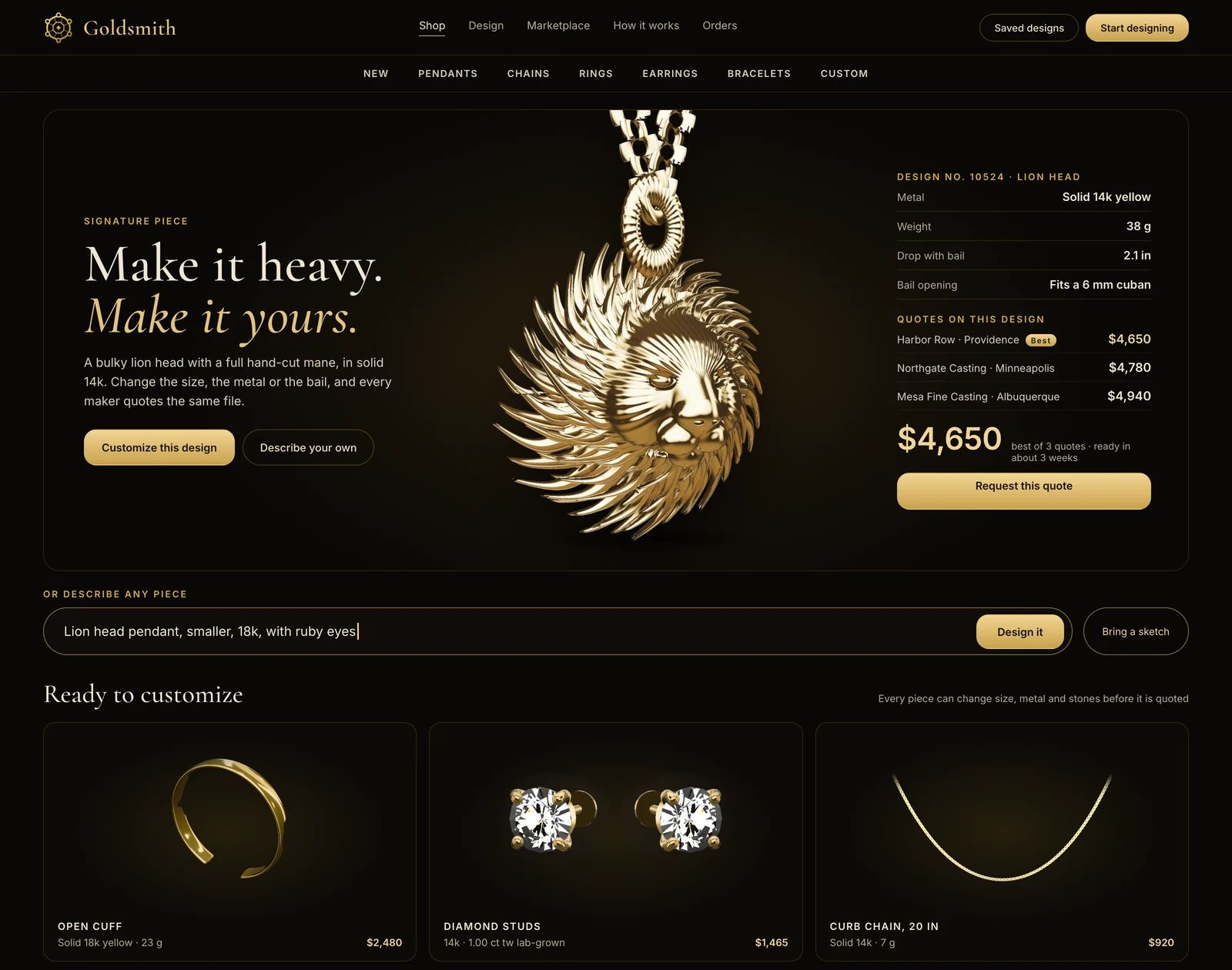
Two parts that depend on each other: the design tool creates a design a manufacturer can quote on, and the marketplace turns it into a real piece at a price the buyer can compare.
The buyer writes what they want. Goldsmith returns four to six candidates built from versioned, licensed parametric CAD templates, each checked against a manufacturing rule profile. The AI chooses and sizes the geometry; it never draws the solid itself.
The buyer iterates on a candidate, or a jeweler with the full tool edits by hand. Every change is a new version, so undo and restore walk the history instead of overwriting it.
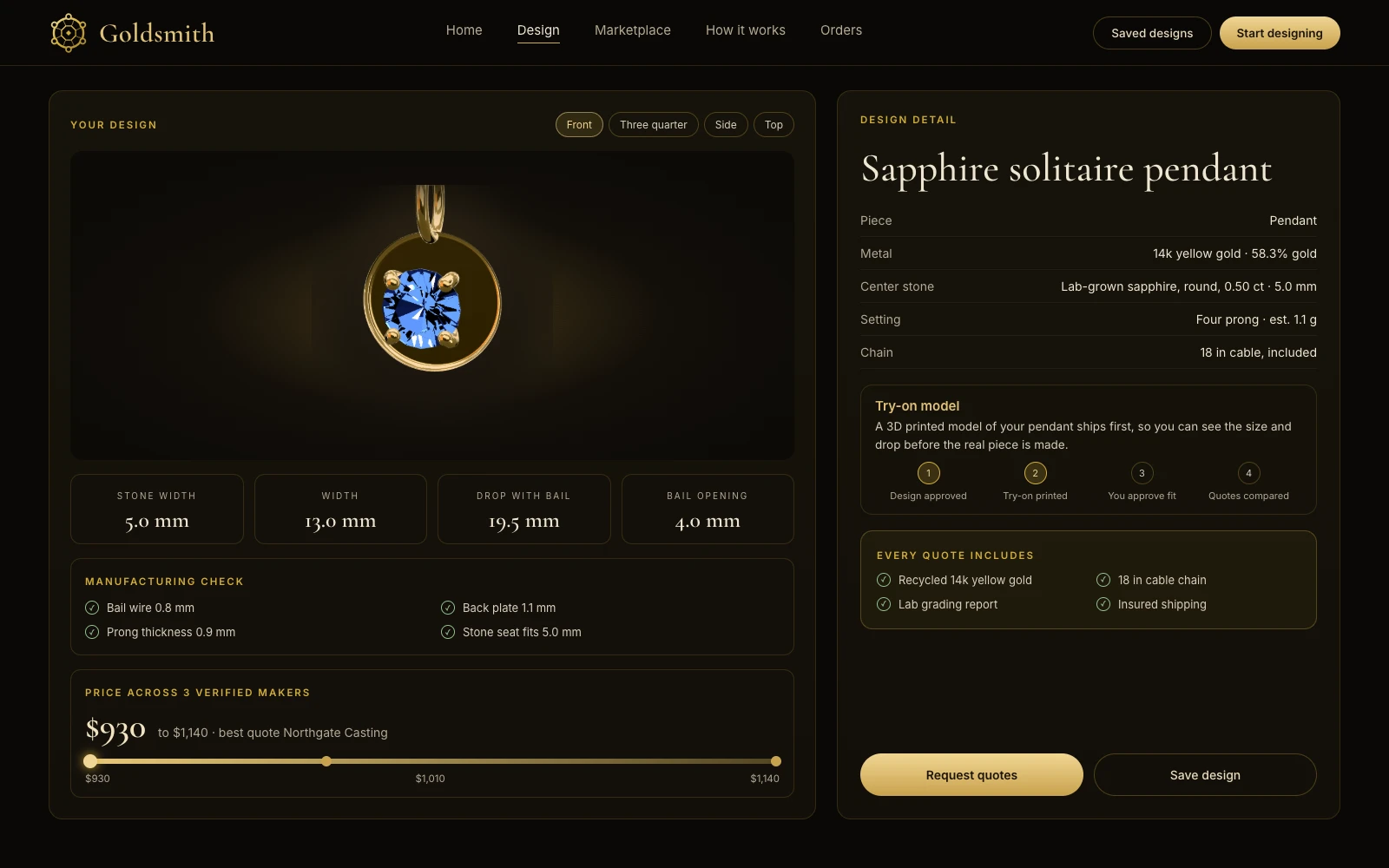
The design goes to verified manufacturers through a request for quotation. Every quote is on the same immutable design file, so the buyer compares price, timeline and services like for like.
The buyer receives 3D-printed models of their top candidates, picks a final design and expects the finished piece in about three weeks. Payment is held until delivery.
[ 02b ] // Architecture
[ 03 ] // How it works, step by step
The AI chooses a template and its sizes. A CAD engine builds the solid and measures it. Nothing a buyer sees has skipped the second half.
The description becomes a structured design: category, setting, metal, size and stones. The result is checked against a fixed format. If it fails twice, the buyer gets a clarifying question, not a guess. A named brand gets a design in that style, with a notice.
Reference tables turn words into dimensions: ring size to inner diameter, carat to millimetres, alloy to density. If the text and the pickers disagree, such as 18k in the sentence and 14k in the picker, the buyer is told.
Four to six candidates come from licensed templates. Each differs from the others in at least one style choice, such as the setting, the shank, the gallery, the bail or the clasp.
Each candidate is built as a real solid by an open-source CAD kernel, in a locked-down worker with no network access and a time limit. Only templates whose code matches the reviewed registry can run.
The engine measures the solid: wall thickness, band width, prongs, the stone seat, and whether the mesh is watertight. Where a setting can fix a failure, it is adjusted and the card says so. A candidate that can’t be made valid is never shown.
A passing design exports as the files a workshop uses: STEP, true-size STL, a try-on STL with the stones as separate bodies, GLB and OBJ. The quote package adds the check report, the specification sheet and a hash of every file.
Two loops close the system. Failed checks send fixes back into the design before anyone sees it. Quotes and try-on results send the buyer back to refine, and every accepted change is a new version, so nothing a manufacturer quoted on is ever overwritten.
The template families cover five kinds of piece. Rings: prong solitaires with four, six or eight prongs, bezels, halos, three-stone rings and plain bands. Pendants: solitaire, halo, bar, disc and teardrop. Earrings, built as a mirrored pair: studs, hoops and drops. Bangles and cuffs. Stock chains for necklaces and chain bracelets.
[ 03b ] // How it is tested
A design is checked against a manufacturing rule profile every time it changes. These are the platform’s starting values. Each manufacturer’s own limits replace them, and changing the manufacturer runs the checks again.
| Rule | Starting value | Why it matters |
|---|---|---|
| Prong thickness | ≥ 0.8 mm | Thin prongs bend or break when the stone is set. |
| Minimum wall | ≥ 1.2 mm | Thin walls can fail in casting. |
| Band width | ≥ 1.5 mm | Keeps the shank strong enough to resize. |
| Stone seat | = stone | The seat matches the stone’s diameter. A loose seat means a loose stone. |
| Mesh | Watertight | Printers and casters need a closed solid. There is no automatic fix: a design that fails is dropped. |
Standard industry reference values, kept in versioned tables so the design, the stone and the size always agree.
What the evaluation measures. The 324 test prompts run through the whole chain, from interpreting the words to the engine’s own measurements. The report covers whether each design is valid, whether it matches what was asked for, how many candidates came back and how different they are, how many pass the rules after automatic fixes, and how long it took.
What the 24 adversarial prompts are. Unsupported pieces, brand names, a metal named two ways, contact details, prompt injection, empty text, over-long text, nonsense and abusive engraving. A description longer than 1,000 characters is refused, never silently cut. Only the description is sent for interpretation, with email addresses, phone numbers and links masked.
What the engine was swept on. Two sweeps of 1,296 and 840 ring combinations were built to test the geometry itself. Every buildable design came out as one valid solid, with nothing intruding into the finger hole.
[ 04 ] // Results so far
The baseline every later build is gated against: a drop of more than two points in any category blocks the release.
| Category | Prompts | Manufacturable after fix | First design (median) | All candidates (95th pct.) |
|---|---|---|---|---|
| Rings | 120 | 98.8% | 0.8 s | 5.2 s |
| Pendants | 50 | 98.4% | 0.9 s | 4.9 s |
| Earrings | 50 | 100% | 1.0 s | 4.8 s |
| Necklaces | 40 | 100% | 0.1 s | 4.3 s |
| Bracelets | 40 | 100% | 0.1 s | 4.2 s |
Synthetic 324-prompt golden set (including 24 adversarial prompts, all handled), run locally on 9 Nov 2026. Targets from the specification: first design within 15 s, all candidates within 60 s. Known gap: only half of necklace prompts get four to six candidates today.
[ 04c ] // What makes it different
Every design is built from a parametric template with known ranges, so it can be measured, fixed and rebuilt exactly.
Goldsmith is built on open-source design software, with the AI on top of it, so the effort goes into the product and not into writing a modeler.
Every template is written, commissioned or licensed in writing, and each carries a record of where it came from. A jeweler’s catalog is their livelihood.
Reference data and rule checks catch problems before a manufacturer sees the file, on every edit and not only at the end.
Verification is what makes a buyer willing to compare offers from strangers.
A 3D-printed model lets a buyer judge scale and fit, and makes the wait easier to accept because they have already seen the thing.
[ Au ] // The gold standard, here
Every Aurifex product must solve a real problem, be proven before it ships, and be effortless to use. Here is what that means for Goldsmith.
Custom jewelry is marked up 200% to 500%, buyers can’t tell a fair price, and small jewelers lack the tools to compete.
Every design is checked against a manufacturing rule profile before it can be quoted; 98%+ pass after automatic fixes on a 324-prompt test set.
Describe it in plain words, see it in 3D in about a second, hold a printed try-on model, and compare quotes side by side.
[ $ ] // Outlook
| Year | 2027 | 2028 | 2029 | 2030 | 2031 |
|---|---|---|---|---|---|
| Expected net revenue (current trajectory) | $0 | $20K | $110K | $310K | $600K |
| Up to | $0 | $50K | $230K | $630K | $1.2M |
[ 05 ] // Release
Product plan, research plan, business model and financial model.
Design studio, refine editor, marketplace and order journey across five categories, with a 324-prompt evaluation baseline.
Open to buyers, jewelers and verified manufacturers.
[ 06 ] // Three sides
People who want a custom piece without knowing how to design one. They want to describe what they like, see it, and know the price is fair.
Small and mid-size shops without powerful computers or a deep network of verified manufacturers. They want faster designs and a shorter route to production.
Makers who want custom work to fill capacity. Leads that arrive with a finished design and a specification make custom work more profitable.
[ 07 ] // Market
Nobody agrees on the size of the custom slice. The gap comes from what each report counts, so Goldsmith sizes its opportunity from the manufacturers and buyers it can reach.
| Measure (2024) | Estimate | What it counts |
|---|---|---|
| All jewelry sales | $367B–$371B | Two aggregator estimates of global jewelry revenue |
| Custom jewelry services | $1.09B–$3.63B | Services only; the range depends on the publisher |
| Customized jewelry products | $31.8B–$36.2B | Broader definition that includes made-to-order products |
In a 2024 review, none of the common jewelry CAD tools paired design from a text description with a marketplace where manufacturers compete on the same file.
[ 08 ] // Questions people ask
No. You write what you want in plain words and choose from the candidates. Then you change the stone, the metal and the fit with bounded controls, or ask in words and approve the change before it applies.
Rings, pendants, earrings, necklaces and bracelets. Ask for a kind of piece Goldsmith doesn’t support and it says so plainly.
Every version is measured against a manufacturing rule profile, and the report shows what was measured, the limit, and pass or fail. A design that fails and can’t be fixed is never shown.
Every manufacturer quotes on the same frozen design file, in the same line items, so you compare price, timeline and services like for like.
Yes. Your top candidates are 3D-printed at true size as try-on models, with the stone as a separate part. An order names exact design versions, so later edits don’t change what you were sent.
After delivery. Your payment is held until then.
Your designs are private by default, and Goldsmith claims no ownership of them. The version history records every change you made.
A workspace to measure a design, run it against any rule profile, queue renders and export files. You can edit beyond the range a buyer can, under the same checks.
The public launch target is Q4 2027, for buyers, jewelers and manufacturers. Write to info@aurifex.com.
[ AURIFEX ] // More from Aurifex
Goldsmith is an Aurifex product. Every Aurifex product is held to the same gold standard for AI in skilled work.







info@aurifex.com