Planning starts late
Physicians and nurses decide when a patient is medically ready, but the discharge plan often starts after that point instead of before it. They need the expected date early enough to act on it.
Aurifex / Products / Aurifex Healthcare

Aurifex Healthcare predicts when each hospital patient is likely to be ready to leave and where they should go next. It flags likely inpatient rehab candidates in the Epic worklist and drafts the referral, so case managers review and send instead of starting from scratch.
Live
25,000 held-out historical admissions, expert-labeled reference cases and 60 simulated referrals. Not randomized; not independently validated.
[ 01 ] // The problem
A patient is medically ready, but the rehab bed, the authorization or the equipment isn’t arranged yet. The bed stays full while admitted patients wait in the emergency department. Aurifex Healthcare works on the post-acute part of that delay.
Physicians and nurses decide when a patient is medically ready, but the discharge plan often starts after that point instead of before it. They need the expected date early enough to act on it.
A good rehab referral means reading days of notes for evidence that the patient can handle intensive therapy. In workflow testing that took about 45 minutes per referral.
A pending bed offer, an authorization or a delivery holds a discharge, and the causes aren’t tracked by reason, owner and age. Operations needs a view of the whole unit, not one patient at a time.
[ 01b ] // Who it is for
Discharge and placement was chosen on purpose. The cost of delay is concrete, the people who fix it are a small, identifiable group, and the work that slows them down is reading notes and writing referrals. Hospitals already measure the outcome: length of stay and excess days, adjusted for how sick the patients were.
They plan every discharge on the unit and write the referrals. With Aurifex Healthcare they review Possible IRF flags, edit and send the inpatient rehab referral, and work the barriers they own. Caseload assignments don’t change.
They decide when a patient is medically ready and whether rehab is right. The PM&R consult arrives drafted as a pended order. The attending reviews, edits and signs it, or declines.
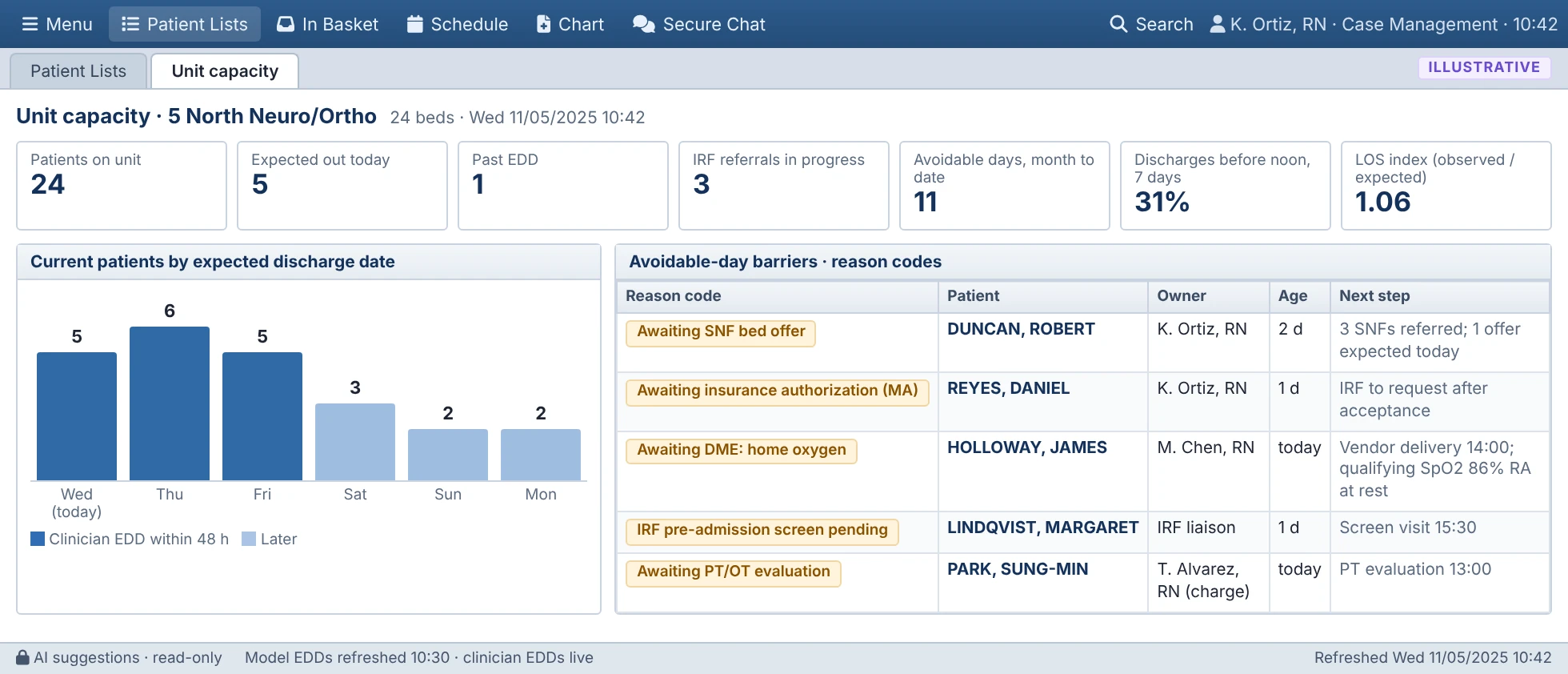
The charge nurse runs the huddle from one unit view: who is expected out today and tomorrow, who is past their expected date, and every open barrier with its owner.
They keep skilled nursing placement, payer and psychosocial work, and use the anticipated next place of care to start earlier.
They carry the cost of every day a patient stays past need. They see length of stay and excess days by unit, measured against each unit’s own baseline and adjusted for case mix.
Standard interfaces, single sign-on through the hospital’s identity provider, role-based access, and an audit trail of every read, draft, edit, approval and rejection.
| Time | Step | What happens |
|---|---|---|
| 7:30 | Huddle | The unit view lists who is expected out today and tomorrow, who is past their expected date and every open barrier with its owner. |
| 9:00 | Worklist | The model’s expected date sits beside the clinician’s for each patient. New Possible IRF flags are at the top, each with a cited summary. |
| 11:00 | Review and send | Open a drafted referral, check the sources, edit what needs it, confirm the patient’s choices and send it. Most days that is one to three drafted referrals. |
| 2:00 | Authorizations and barriers | Medicare Advantage and commercial authorizations show as barriers with their age. Bed offers and equipment deliveries are followed up from the same list. |
| 4:00 | Tomorrow’s plan | Expected discharges for tomorrow are confirmed, and anything still open has an owner and a next step. |
A typical day for a case manager on a unit using Aurifex Healthcare. Huddle times and steps stay the hospital’s own. Flags raised overnight or on a weekend wait in the worklist for the next case-management shift.
[ 02 ] // The product
The case manager’s day starts in the worklist they already open every morning. Aurifex adds to it; it never replaces what clinicians enter.
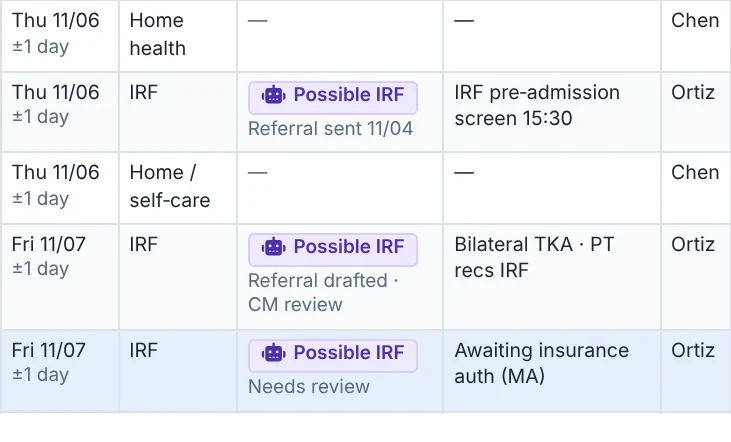
Aurifex adds its expected discharge date next to the clinician-set date, which it never overwrites, plus the likely next place of care and a flag on possible inpatient rehab (IRF) candidates. The morning huddle starts with the patients who need a plan today.
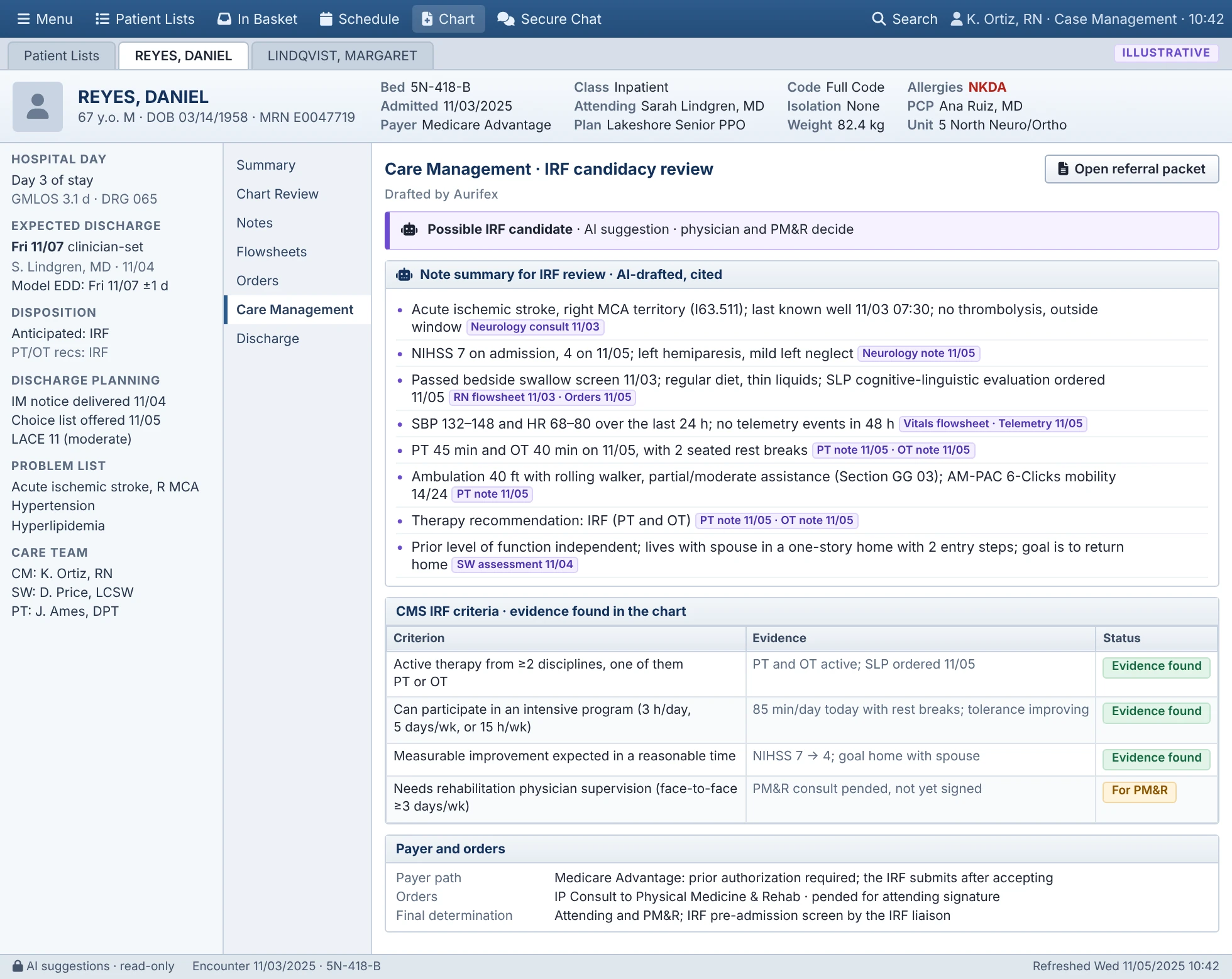
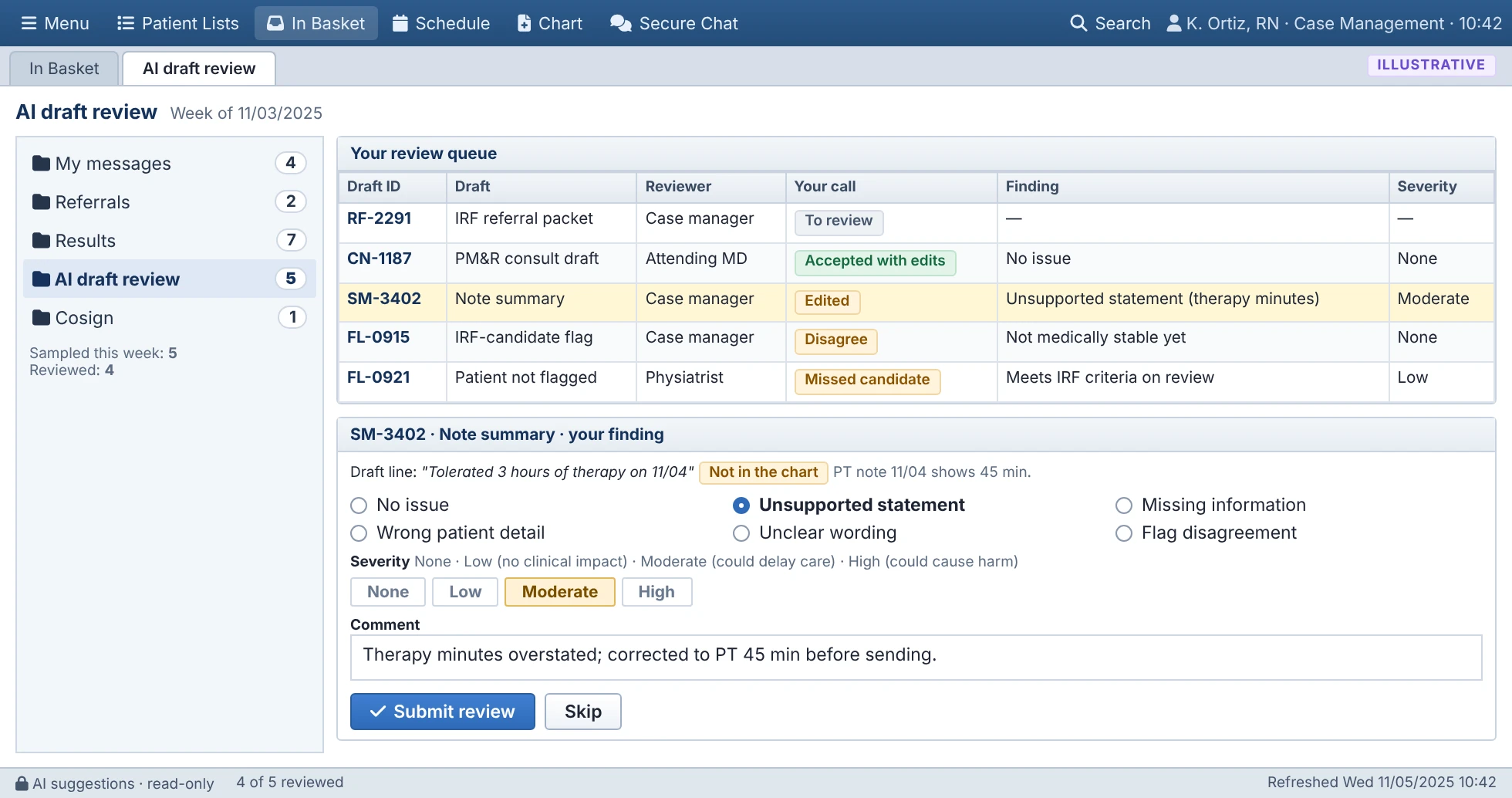
For a flagged patient, the agents have already read the notes. The candidacy review lays out the evidence against the four CMS criteria for inpatient rehab, and every statement links to the note it came from.
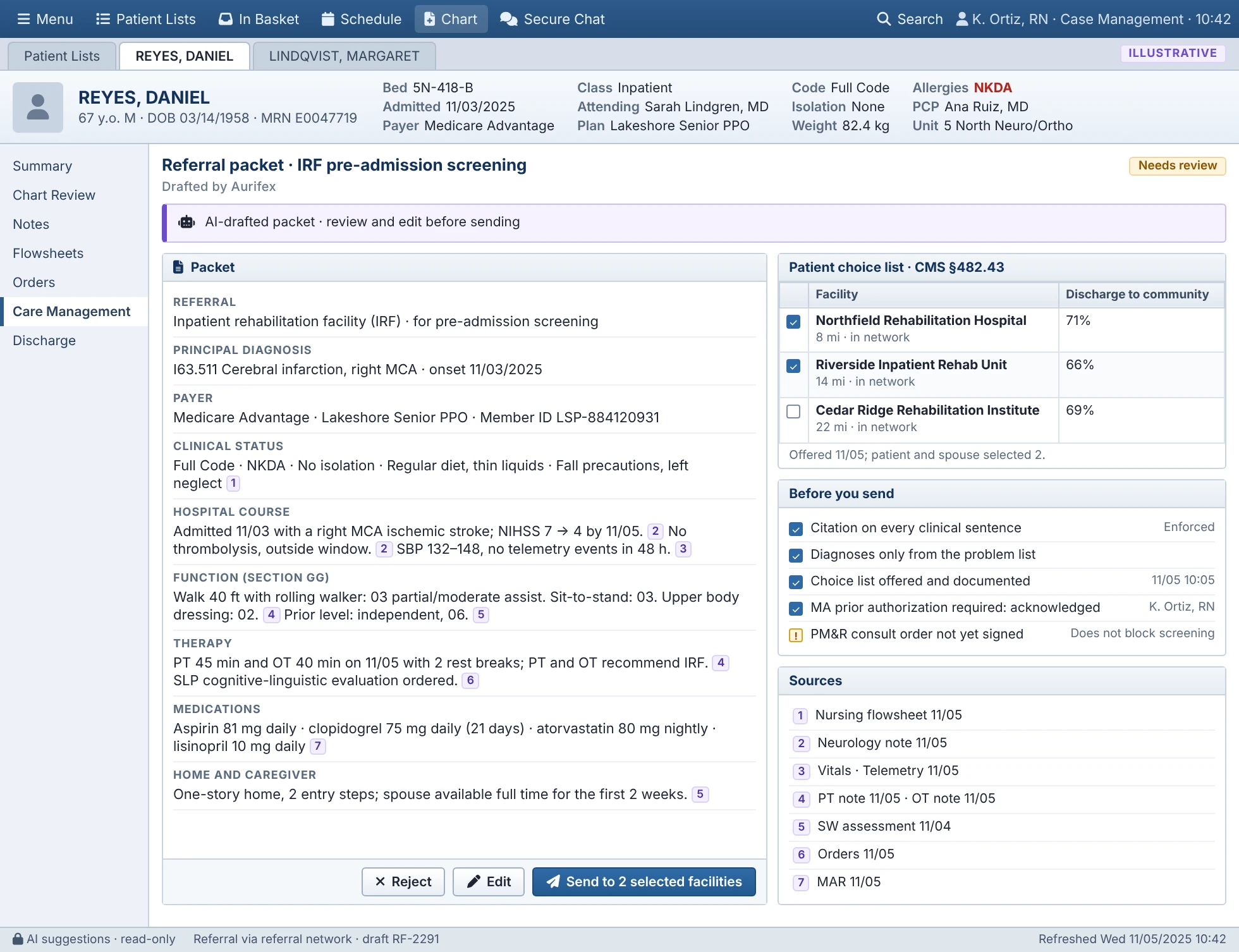
The referral packet arrives drafted, with numbered sources. The case manager reads the packet instead of days of notes, fixes anything wrong, offers the patient a choice of facilities and sends it to the ones they pick. Nothing is sent on the agent’s say-so.
[ 03 ] // Architecture
The discharge date comes from a gradient-boosted model trained on historical admissions, using structured data, where every prediction can be checked against the real discharge date. Language models handle the free-text notes: reading, citing and drafting.
Every change must pass a 1,200-case evaluation suite before it merges, including 40 of 40 prompt-injection tests and no more than a three-point accuracy gap across patient groups. Readmissions and emergency returns are tracked as balancing measures, so a shorter stay can’t hide a worse outcome.
[ 03b ] // How it works, step by step
Six steps, in the order they happen. Aurifex Healthcare reads through standard interfaces, shows its results where case managers and physicians already work, and files nothing until a person approves it.
An HL7 v2 ADT feed reports every admission, transfer and discharge. FHIR R4 APIs supply encounters, conditions, vital signs, labs, medication orders, coverage and clinical notes. Each part of the system requests only the data its task needs.
A gradient-boosted model reads the structured data and predicts the discharge date and the next place of care. The date is made on admission and revised as notes arrive. The model is designed to be refit on each hospital’s own history.
The evidence a rehab facility wants lives in free text: how far a patient walks, how much therapy they tolerate, who is at home. Language-model agents read the notes for it, with the CMS coverage criteria as a guide, and cite the note behind every sentence.
The expected date, the next place of care and the Possible IRF flag appear as read-only columns labelled as Aurifex suggestions. They never overwrite a clinician’s field, and there are no pop-up alerts at the bedside.
The case manager opens the candidacy review and the drafted packet, checks the sources and edits. A draft can’t be sent or signed until the reviewer has opened it. The PM&R consult waits as a pended order for the attending’s signature.
The packet is sent only to the facilities the patient picked, under the case manager’s name, and the action is logged. Reviews and edits feed the evaluation.
| Work | Aurifex Healthcare | A person |
|---|---|---|
| Discharge date | Predicts an expected discharge date and next place of care | Sets the expected discharge date of record and decides discharge readiness |
| Rehab candidacy | Flags possible inpatient rehab candidates | Determines candidacy, with the attending and PM&R. The rehab facility screens every referral |
| PM&R consult | Drafts the consult as a pended order | The attending reviews, edits and signs, or declines |
| Referral packet | Drafts the packet and the facility choice list | The case manager reviews, edits and sends it to the facilities the patient chose |
| Barriers | Lists barriers and suggests next steps | The unit team assigns owners and acts |
[ 04 ] // Decisions
A case manager approves, edits or rejects every referral, and the attending signs the consult.
Flags, dates and drafts appear in the worklist case managers already use, so Aurifex is part of the job rather than one more login.
Every statement in a summary or draft must cite the note it came from.
[ 05 ] // Evaluation
25,000 de-identified historical admissions held out from training, plus expert-labeled reference cases and simulated referral work. Not randomized and not independently validated.
| What was tested | Result | How it was measured |
|---|---|---|
| Expected discharge date | 85.3% | Within one day of the actual discharge (95% CI 84.9–85.7%), from day 2 of the stay. Mean absolute error 0.6 days. Clinician-entered dates on the same admissions: 58% within one day. |
| Next place of care | 82% | Predicted next place matched the actual one (top-1) on held-out admissions. |
| Rehab-candidate flags | 0.91 | AUROC on 2,000 reference admissions labeled by 3 PM&R physicians and 2 case managers (kappa 0.82). 88% recall, 80% precision at the worklist threshold. |
| Drafted PM&R consults | 85% | Of 400 drafts rated acceptable as written or with minor edits, in blinded review by 6 clinicians. |
| Hallucination rate | 1.5% | Of 6,000 drafted statements unsupported by their cited source, counted per statement. |
| Referral prep time | 45→10 | Median minutes per IRF packet across 60 simulated cases timed with 6 case managers, including the reviewer’s check. |
Still open: whether discharges before noon and emergency department boarding change, and how much staff time Aurifex takes beyond referral prep.
[ 05b ] // How it is tested
Before a model or prompt reaches clinicians, it is tested against an evaluation set and has to pass every gate. The levels are set with each hospital and written into the pilot plan.
| Gate | Level | How it works |
|---|---|---|
| A source on every clinical sentence | Enforced | An automated check removes statements without a source before a person reviews the draft. |
| Hallucination rate | ≤ 2% | Counted per statement, to start. The final level is agreed with the hospital. |
| Critical omissions | None | Allergies, code status and isolation are checked against the chart before a packet can be sent. |
| Accuracy | No drop | Discharge-date accuracy and flag agreement at or above the current version, overall and for each patient group checked. |
| Balancing measures | ≤ 1 pt | 30-day readmissions no more than 1 point above the hospital’s baseline to start. If crossed, the feature pauses. |
| Go-live sign-off | Both | The hospital and Aurifex both sign off before clinicians see anything. |
The gates sit on top of the engineering gate. Every code change has to pass the 1,200-case evaluation suite before it merges: accuracy, source checks, 40 prompt-injection tests, and no more than a 3-point accuracy gap across age, sex and race groups. More than 300 changes were merged behind that gate on the way from first idea to working product, in about 6 months.
Fairness is checked by patient group, with the smallest group in testing at 900 admissions. Race, ethnicity and preferred language are not model inputs. They are used only to check fairness. Before go-live the review also covers traditional Medicare and Medicare Advantage, dual-eligible patients, patients 85 and older and patients with a disability.
After go-live the same measures are monitored weekly. A feature that drifts below the agreed level pauses until a reviewed fix is released, starting with a 5-point drop in within-one-day accuracy over 2 weeks. Clinicians review a weekly sample of drafts and flags with patients hidden. Nothing changes in production automatically.
[ 07 ] // Questions hospitals ask
No. It predicts, flags, summarizes and drafts. Case managers and physicians decide, and nothing is sent, ordered or filed without a named person’s approval.
Patients whose notes show a qualifying condition, therapy recommendations, tolerance for intensive therapy, medical stability and a realistic goal of improvement. The flag is a prompt to look. Candidacy is decided by the attending and PM&R.
A case manager can open the candidacy review for any patient, and a patient who isn’t flagged is referred through the usual process. In testing the flag caught 88% of candidates at the worklist threshold. Missed candidates are a standing category in weekly clinician review.
No. Day-to-day work happens in the Epic worklist, the chart and pended orders. The outcomes dashboard is a separate reporting site for leaders.
Through standard interfaces: an HL7 v2 ADT feed and FHIR R4 APIs, on Epic 2023 and later, through the hospital’s own Epic build. It is not an app hosted by Epic, and Aurifex claims no Epic partnership or listing.
In US-hosted cloud infrastructure, encrypted in transit and at rest, under a business associate agreement. The language model sees only the note excerpts a draft needs, with names and record numbers replaced by tokens. The model provider keeps no data and does not train on it.
Yes. Baseline, patient and payer mix, the post-acute network and use all matter, which is why results are measured against each hospital’s own baseline, adjusted for case mix.
As avoided excess days valued at the hospital’s own cost per patient day. That is cost avoided, not cash, and it depends on whether freed beds are refilled. Savings stay labelled as projected until the hospital’s finance team confirms them.
An executive sponsor, a case management lead, a physician or PM&R champion, an IT or interface analyst and a compliance contact.
[ Au ] // The gold standard, here
Every Aurifex product must solve a real problem, be proven before it ships, and be effortless to use. Here is what that means for Aurifex Healthcare.
A case manager spends about 45 minutes reading days of notes to build one rehab referral, while patients who are ready wait for the next place of care.
Tested on 25,000 held-out historical admissions, and every change must pass a 1,200-case evaluation suite before it merges.
It lives in the Epic worklist case managers already open every morning, so there is nothing new to log into.
[ $ ] // Outlook
| Year | 2027 | 2028 | 2029 | 2030 | 2031 |
|---|---|---|---|---|---|
| Expected net revenue (current trajectory) | $0 | $30K | $160K | $510K | $1.1M |
| Up to | $0 | $70K | $320K | $930K | $1.9M |
[ AURIFEX ] // More from Aurifex
Aurifex Healthcare is an Aurifex product. Every Aurifex product is held to the same gold standard for AI in skilled work.







info@aurifex.com